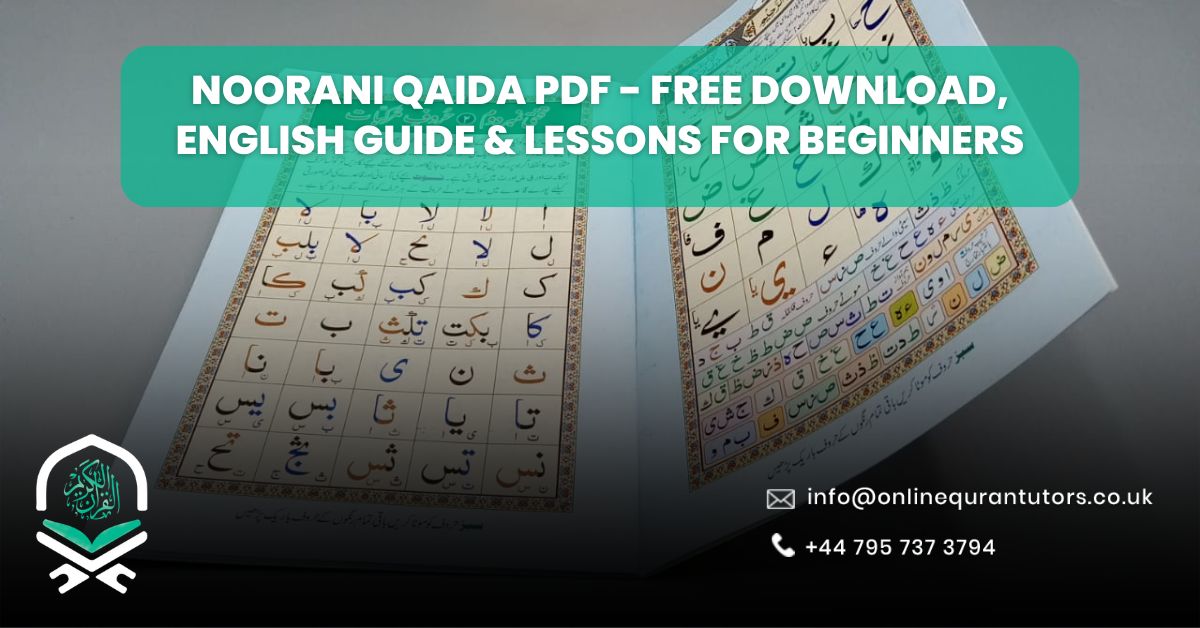
The Noorani Qaida is a foundational booklet used to teach beginners how to read the Quran correctly. It was compiled by Molvi Noor Muhammad Ludhyanvi and is now the most widely used beginner text for Quranic learning across the world.
The book starts with Arabic alphabet recognition and moves progressively through vowel signs, elongation rules, Tashdeed, and Waqf – giving students the pronunciation skills and Tajweed basics they need before opening the Quran.
It is suitable for all ages. At Online Quran Tutor, we teach Noorani Qaida to students from age 4 through to adults. Children typically complete it in 3 to 6 months; adults in 2 to 4 months, depending on learning pace and consistency.
In this guide, you will find a free Noorani Qaida PDF download, a full lesson breakdown, an English guide for UK learners, and details on how to book a free trial class with a certified tutor.
Noorani Qaida PDF Free Download
The Noorani Qaida PDF is available as a free download and contains the complete 32-page booklet used in beginner Quran classes worldwide. It includes all 7 units, from Arabic alphabet recognition through to Waqf (stopping rules), printed in coloured Arabic text to help younger learners distinguish letters more easily.
The PDF can be used on any device including smartphones, tablets, and computers, making it accessible for home study at any time.
At Online Quran Tutor, we provide the Noorani Qaida digitally to all enrolled students as part of the course. No physical textbook is required.
One important note: the PDF alone cannot teach correct pronunciation. Arabic letters must be heard and corrected by a qualified tutor to develop accurate Makharij (articulation points). The PDF is a study aid, not a replacement for guided instruction.
If you have downloaded the PDF and want structured lessons alongside it, book a free trial class with one of our certified UK tutors and start learning today.
Noorani Qaida in English – A Guide for UK Learners
The standard Noorani Qaida is written entirely in Arabic script. For learners in the UK who have no prior Arabic knowledge, an English Noorani Qaida PDF includes transliteration alongside the Arabic text, helping students understand how each letter and vowel sound should be pronounced using familiar English phonetics.
This is particularly useful for:
Parents teaching young children at home who are not confident in Arabic themselves. Adult beginners who need a reference point while practising independently between classes. Students who understand English instructions better than Arabic or Urdu explanations.
At Online Quran Tutor, all classes are conducted in English. Our certified tutors explain every rule, letter, and pronunciation point in clear English, making the course fully accessible to UK-born students and non-Arabic speakers of all ages.
The English Noorani Qaida PDF is a helpful supplement, but correct pronunciation still requires live guidance. Transliteration gives an approximate sound, not an exact one. A qualified tutor ensures each letter is coming from its correct articulation point from the very first lesson.
Noorani Qaida Lessons – What You Will Learn Step by Step
The Noorani Qaida is structured into 7 units, each building directly on the previous one. Below is a breakdown of what each unit covers.
Unit 1: Arabic Alphabet (Noorani Qaida Lesson 1)
Lesson 1 introduces the 29 Arabic letters in their isolated form. Students learn to recognise each letter visually, understand its name, and pronounce it from its correct Makharij (articulation point). This is the most critical unit in the entire book. Errors formed here carry through every subsequent lesson, which is why tutor correction from the very first class is essential.
Unit 2: Short Vowels (Harakaat)
Students learn the three short vowel signs: Fatha (zabar), Zamma (pesh), and Kasra (zer). These signs change how a letter is pronounced and are applied to every letter in the Arabic language.
Unit 3: Sukoon and Madd
Sukoon indicates the absence of a vowel, requiring the letter to be pronounced with a brief stop. Madd refers to the elongation of certain vowels. Students learn when and how long to stretch a sound during recitation.
Unit 4: Tanween (Nunation)
Tanween adds a Noon sound to the end of Arabic words without a written Noon letter. Students learn the three forms of Tanween and how each affects word endings in Quranic recitation.
Unit 5: Shadda (Tashdeed)
Shadda doubles a consonant, requiring the letter to be pronounced with added stress. Students learn how to identify the Shadda sign and apply the correct weight and rhythm to the letter in recitation.
Unit 6: Hamzatul Wasl
Hamzatul Wasl is a connecting Hamza that allows two words to be joined smoothly in recitation. Students learn when it is pronounced and when it is silent depending on its position in a sentence.
Unit 7: Stopping at the End of Words (Waqf Rules)
The final unit covers the rules of stopping during recitation. Students learn where it is correct to pause, where stopping is obligatory, and how stopping affects the pronunciation of the final letter in a word.
After completing all 7 units, students sit a level examination and quiz to assess their understanding before progressing to Quran reading.
Noorani Qaida for Kids – A Specially Designed Programme
The Noorani Qaida for Kids programme at Online Quran Tutor is structured into three levels, allowing young learners to progress at a pace suited to their age and ability.
Level 1: Beginner
Students learn the Arabic alphabet, recognise each letter in its isolated form, and begin understanding basic letter sounds.
Level 2: Intermediate
This level covers Harakaat (short vowels), joining letters together, and an introduction to basic Tajweed rules.
Level 3: Advanced
Students learn advanced Tajweed rules including Noon Sakin, Tanween, and Meem Sakin, and begin practising full Quranic recitation with accuracy.
All kids classes are one-on-one, 30 minutes per session, conducted via Zoom, and taught in English. Tutors use quizzes, games, and interactive activities throughout each session to keep younger learners engaged.
The course is open to children from age 4. Most children complete the full Noorani Qaida programme within 3 to 6 months with regular weekly classes.
A free trial class is available before enrolment so parents can assess the teaching style and session format before committing.
Why Learning Noorani Qaida Online Is More Effective
Traditional Noorani Qaida learning typically takes place in mosques or madrassas in group settings. While accessible, group classes limit the amount of individual attention a student receives. A tutor managing 10 to 20 students cannot correct every child’s pronunciation in real time.
Online one-on-one classes remove that limitation entirely.
One-on-One Attention
Every session at Online Quran Tutor is a private class between the student and the tutor. The tutor listens to every letter, corrects every mistake, and adjusts the pace based on individual progress. This produces faster, more accurate results than any group setting.
Learn from Home
Classes are conducted via Zoom. Students need only a device with internet access. There is no commute, no fixed location, and no disruption to the family routine.
Flexible Scheduling
Classes are available 7 days a week. Timings can be selected to fit around school, work, or other commitments. If a class is missed, rescheduling is available to keep progress on track.
Certified Tutors
All tutors at Online Quran Tutor are certified in Tajweed and experienced in teaching Noorani Qaida to both children and adults. Progress is monitored after every session and detailed feedback is provided to parents and students.
Free Trial Class
A free trial class is available before any commitment is made. This allows students and parents to experience the teaching quality, meet the tutor, and assess whether the course is the right fit.
To book your free trial class, contact us via WhatsApp on +44 795 737 3794 or visit our Noorani Qaida course page.
Start Your Noorani Qaida Journey with a Free Trial Class
The Noorani Qaida is the correct starting point for anyone learning to read the Quran. Without it, pronunciation errors form early and become difficult to correct later. With the right foundation, students progress to Quran reading with accuracy, confidence, and proper Tajweed from the start.
At Online Quran Tutor, the Noorani Qaida course is taught one-on-one via Zoom by certified tutors, in English, for students from age 4 through to adults. Sessions are 30 minutes, scheduling is flexible, and all learning materials including the Noorani Qaida PDF are provided digitally at no extra cost.
A free trial class is available with no commitment required.
Frequently Asked Questions
What is Noorani Qaida?
Noorani Qaida is a foundational booklet used to teach beginners how to read the Quran. It covers Arabic alphabet recognition, vowel signs, and basic Tajweed rules before a student progresses to Quran reading.
Is the Noorani Qaida PDF free to download?
Yes. The complete Noorani Qaida PDF is available as a free download. It contains all 7 units in coloured Arabic text and can be accessed on any device.
How many lessons are in Noorani Qaida?
The Noorani Qaida contains 7 units covering the Arabic alphabet, short vowels, Sukoon, Madd, Tanween, Shadda, Hamzatul Wasl, and Waqf rules.
Is there a Noorani Qaida in English?
Yes. An English Noorani Qaida PDF includes transliteration alongside Arabic text to help non-Arabic speakers understand pronunciation. At Online Quran Tutor, all classes are taught in English.
How long does it take to complete Noorani Qaida?
Children typically complete it in 3 to 6 months. Adults complete it in 2 to 4 months. Duration depends on the number of weekly sessions and consistency of home practice.
What age group is the course suitable for?
The course is open to students from age 4 through to adults. There is no upper age limit.
Can I learn Noorani Qaida using just the PDF?
The PDF can support home revision but cannot replace a qualified tutor. Correct pronunciation and Makharij can only be developed through live guided instruction.
What do I need to attend online classes?
A device with internet access and a Zoom connection is all that is required. No physical textbook is needed as all materials are provided digitally.
What if I miss a class?
Rescheduling is available for missed classes to ensure progress is not disrupted.
Are the tutors qualified?
Yes. All tutors at Online Quran Tutor are certified in Tajweed and Hifz with verified teaching experience in both Noorani Qaida and Quran recitation.